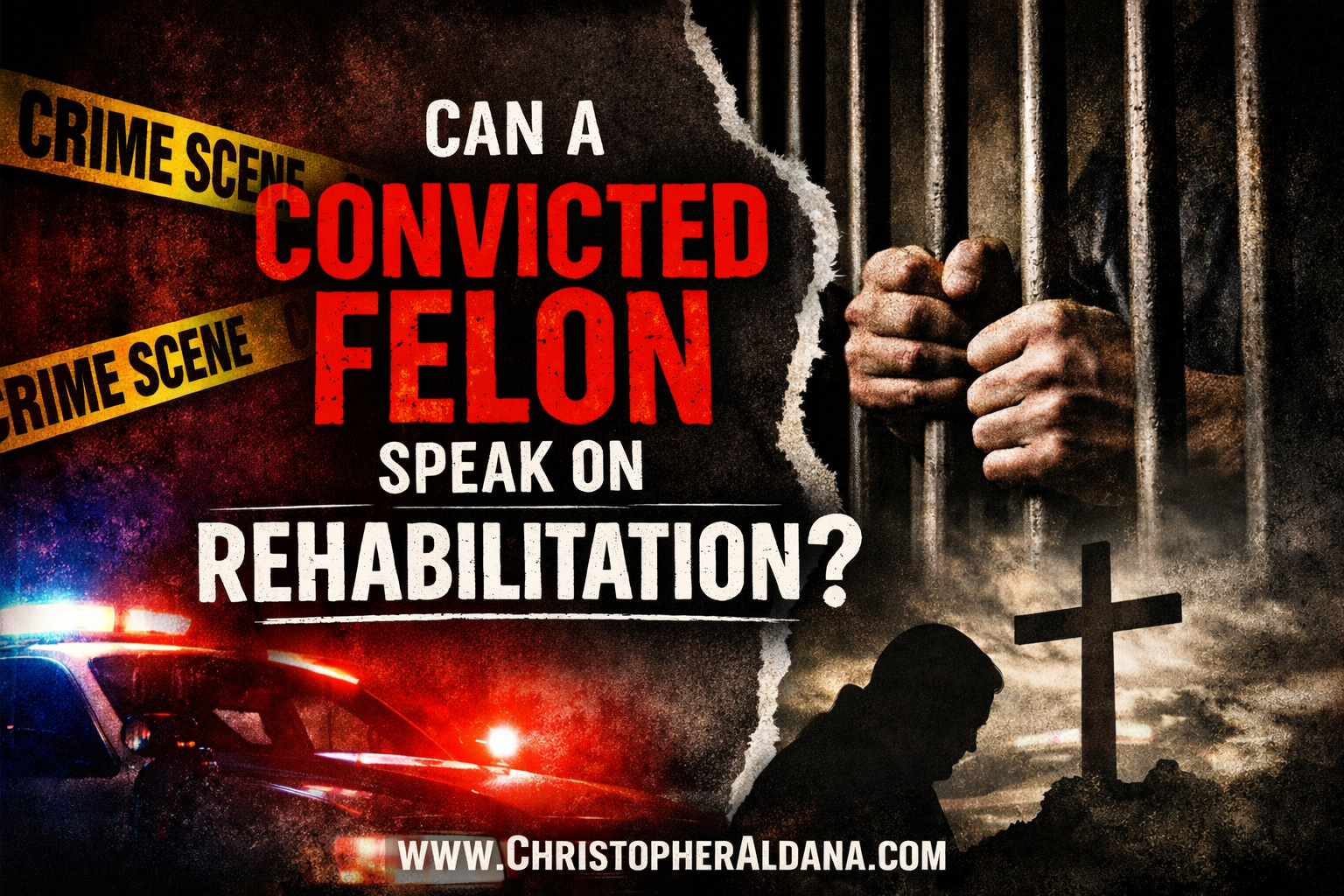
Can a Convicted Felon Speak on Rehabilitation? My Most Controversial Q&A Yet
I recently completed a powerful phone interview Q&A about my book, From Crime Scene to Community Return, and I am proud to share the transcript with you today. This conversation highlights the heart behind the book, my personal journey, and the message of accountability, rehabilitation, and redemption that continues to shape my mission. The video will be coming soon, but I wanted to make this interview available now. Thanks for your support as I share my journey to rehabilitation.
-Christopher1. Why should anyone listen to a convicted felon talk about rehabilitation?
Because I am not speaking about rehabilitation as a theory. I am speaking about it as a lived reality. I know what it means to fail, to face consequences, to lose credibility, and to have to rebuild one honest step at a time. I do not ask people to trust me because I am perfect. I ask them to hear me because I have walked through collapse, accountability, and the difficult work of restoration. My life is not an argument against consequences. It is an argument that consequences do not have to be the end of the story. I believe some of the strongest voices on healing and rehabilitation are people who have had to fight for both.
2. Are you using bipolar disorder to excuse what happened in your life?
No. I am not excusing anything. I am telling the truth about it. There is a difference. Mental illness can help explain context, instability, and impaired judgment, but it does not erase responsibility. One of the reasons I speak so openly is because I want to reject two dangerous extremes. The first is pretending mental illness has nothing to do with destructive choices. The second is acting like mental illness removes all accountability. I reject both. My message is that people need real treatment, real support, and real accountability at the same time. That is exactly why I built The Four Pillars Model around the Psychiatry Pillar, Therapy Pillar, Family Pillar, and Faith Community Pillar. Healing without accountability is incomplete. Accountability without healing is also incomplete.
3. Are you more concerned about offenders than victims?
No. I care deeply about victims, and I believe any serious conversation about justice has to begin there. Harm is real. Damage is real. Trauma is real. What I reject is the idea that caring about victims requires us to give up on rehabilitation. Justice and rehabilitation are not enemies. In my view, true justice tells the truth about harm, honors the dignity of those who were hurt, and still leaves room for responsibility, change, and repair where possible. I do not minimize what people suffer. I also do not believe society becomes stronger by deciding that broken people can never become accountable, healthy, and safe again. My work is not anti-victim. It is pro-truth, pro-accountability, and pro-restoration.
4. Do you believe everyone deserves a second chance?
I believe every human being is made in the image of God and therefore has dignity that does not disappear after failure. But I do not use the phrase second chance in a cheap or sentimental way. Restoration is not automatic. Trust is not automatic. Access is not automatic. Some people hear second chance and think it means pretending the damage never happened. That is not my message. My message is that no one should be reduced forever to the worst thing they have done, but everyone must face the truth about what they have done. Grace and accountability belong together. Redemption is possible, but it is not casual. It costs honesty, humility, structure, treatment, and time.
5. Are you soft on crime?
No. I am serious about crime because I am serious about consequences, victims, public safety, and moral responsibility. What I oppose is shallow thinking. Too often people act like there are only two options: punishment with no restoration, or compassion with no accountability. I reject that false choice. A mature justice system should protect the public, tell the truth about harm, require accountability, and create pathways for genuine rehabilitation where appropriate. That is not softness. That is seriousness. It is much easier to write people off forever than it is to build systems that demand responsibility and make change possible. My work stands for both order and mercy, both truth and hope.
6. Why bring faith into conversations about mental health and justice?
Because faith has been part of my real recovery, and I am not interested in giving people a version of healing that edits out what has actually mattered in my life. At the same time, I do not believe faith replaces psychiatry, therapy, or family support. That is exactly why the Faith Community Pillar is one pillar, not the whole structure. My model is intentionally balanced. The Psychiatry Pillar matters. The Therapy Pillar matters. The Family Pillar matters. The Faith Community Pillar matters. Faith gave me meaning, accountability, hope, and a community that called me toward responsibility. I talk about it because it is true in my story. I do not force it on people. I present it honestly as one essential part of the healing architecture that helped save my life.
7. Is your book trying to make people feel sorry for you?
No. I did not write this book to ask for sympathy. I wrote it to tell the truth. There is a difference between self-pity and honest testimony. My goal is not to present myself as a victim of life. My goal is to show what it looks like when a person takes responsibility for serious consequences and still believes healing, rehabilitation, and redemption are possible. If readers feel compassion, I welcome that. But I also want them to feel challenged. I want them to think more deeply about dignity, responsibility, and what it really takes to rebuild a life after crisis. This book is not a plea for lowered standards. It is a call to higher standards rooted in truth and restoration.
8. How can people trust you now after what has happened in your past?
I would say trust should not be demanded. It should be built. I do not expect people to hand me credibility because I can speak well about healing. Credibility comes from consistency, humility, and time. It comes from whether my life matches my message. One of the reasons I write and teach publicly is because I believe accountability should be visible. I am not asking people to forget my past. I am asking them to judge my life by the full picture, including what I have done to face the truth, pursue treatment, rebuild character, and serve others. Real trust is not built by hiding the worst chapter. It is built by living honestly after it.
9. Are you turning your worst mistakes into a business?
I understand why people ask that, and I take the question seriously. My answer is this: I am turning pain into purpose, not into spectacle. There is a difference. I do not exploit my story to glorify failure. I use it to serve people who need language for recovery, accountability, and hope. Writing, teaching, and advocacy are part of my vocation now, and I believe it is honorable to build work that helps others from the lessons I learned the hardest way possible. The issue is not whether someone earns income from meaningful work. The issue is whether the work is truthful, useful, and responsible. I believe mine is. I am trying to build something that gives people a framework for healing, not a performance built on shock.
10. Is The Four Pillars Model just your opinion dressed up as a framework?
It is more than opinion because it grows out of lived experience, practical observation, and the reality that healing is rarely one-dimensional. People do not recover in isolation, and they do not recover through one intervention alone. That is the core insight behind the model. The Psychiatry Pillar addresses medical and clinical stability. The Therapy Pillar addresses insight, patterns, and emotional work. The Family Pillar addresses the home and relational environment. The Faith Community Pillar addresses meaning, belonging, and moral support. I am not claiming I invented the need for those things. I am saying I organized what I learned into a framework people can actually understand and use. My model is grounded, practical, and designed to help people build a balanced life instead of chasing one incomplete answer.
11. Should churches really welcome people with serious legal histories?
Yes, with wisdom, honesty, boundaries, and accountability. The church is not called to be naive, but it is also not called to be a museum for the already polished. The church should be one of the places where redemption is taken seriously. That does not mean every person should be given every role. It does not mean trust should be restored overnight. It does not mean safety protocols should be ignored. It means the body of Christ should know how to hold both grace and order at the same time. I believe churches should be places where truth is told, boundaries are respected, healing is supported, and people are invited into faithful transformation. If the church cannot make room for repentance, responsibility, and restoration, then it has forgotten part of its own message.
12. Why speak so openly about your own failure instead of protecting your privacy?
Because silence can become a prison of its own. For a long time, shame convinces people that hiding is safer than healing. I know that mentality well. But I have learned that when truth is brought into the light, it can begin to serve a purpose larger than your own fear. I do not share everything, and I do believe in wise boundaries. But I have chosen not to build my public work on a false image. Too many people are suffering in silence because they think honesty will destroy them. I want my life to say something different. Truth may cost you comfort, but it can also become the beginning of freedom, responsibility, and real healing.
13. What are you planning to write and teach next, and why should people keep listening to you?
I plan to keep writing and teaching on the themes that have become central to my life and work: mental health recovery, accountability, rehabilitation, redemption, faith, and structured healing. I am not interested in chasing whatever topic is safest or most fashionable. I want to build a body of work that helps people live with greater honesty, greater stability, and greater hope. That includes the future development of The Restoration Voyage series and continued teaching around The Four Pillars Model. Why should people keep listening? Because I intend to keep doing the hard work of integrity. I want my writing to remain practical, truthful, and deeply human. I do not offer people perfection. I offer them witness, structure, and a message that healing is possible without denying responsibility.