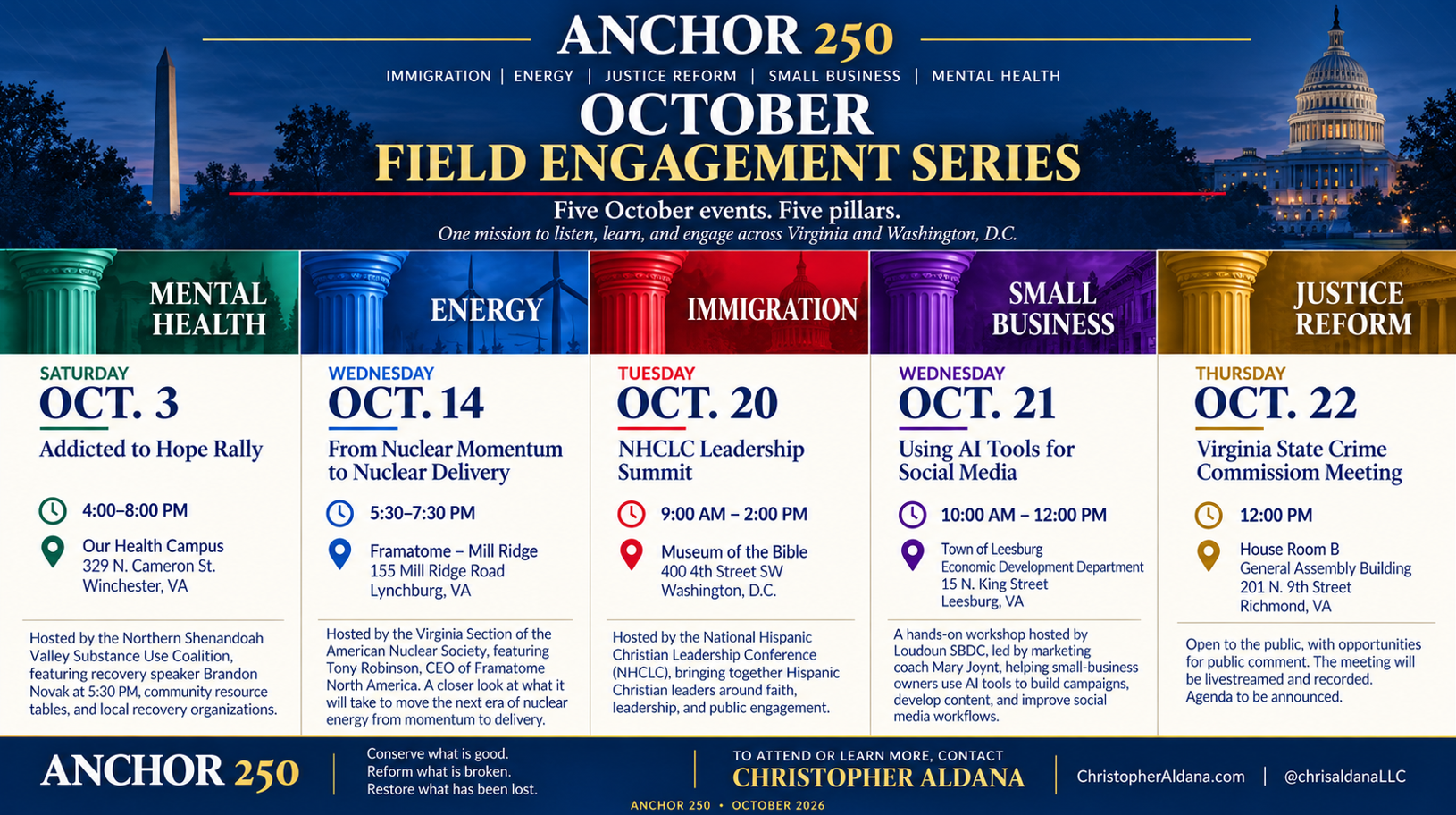
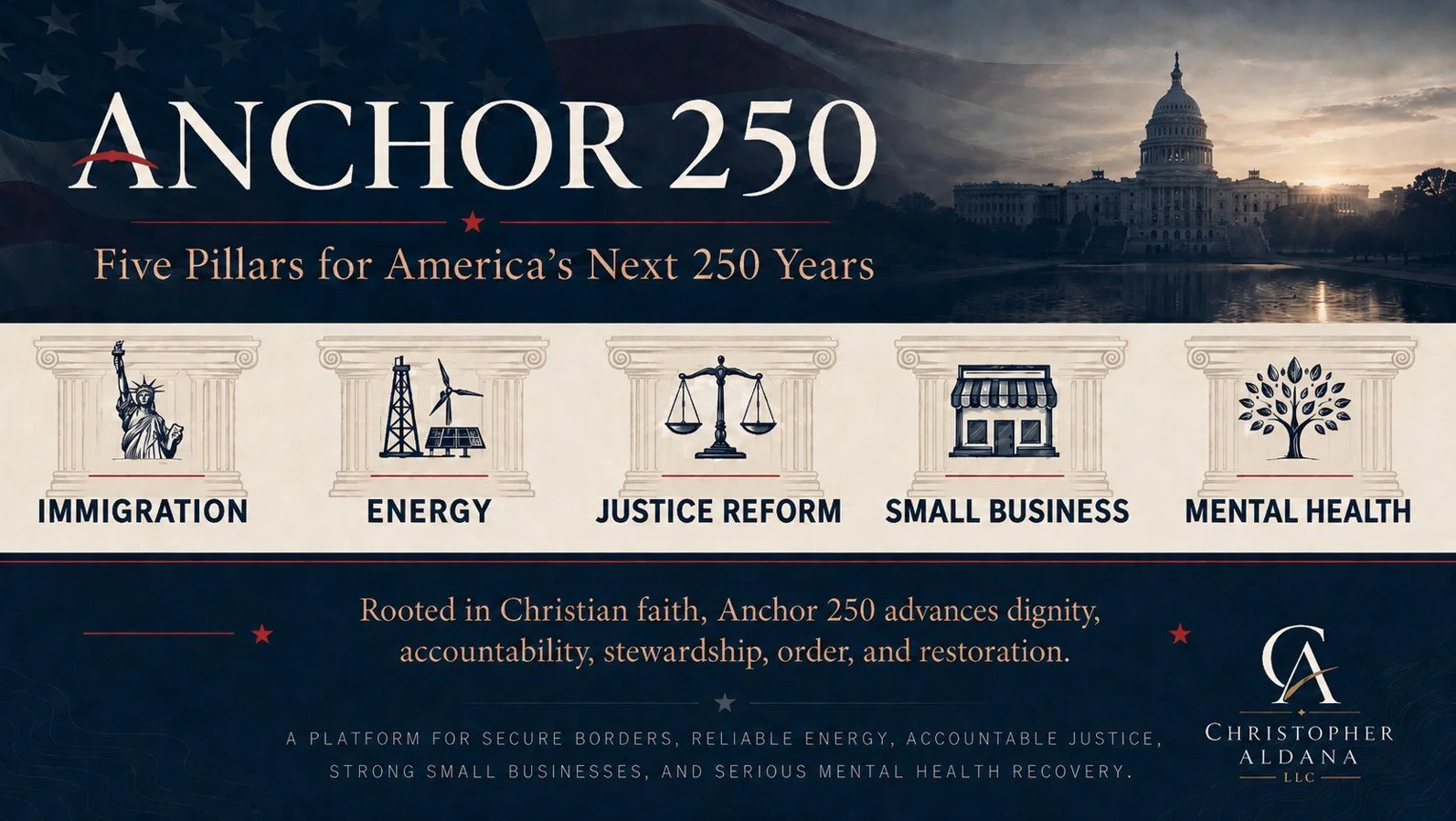
Christopher Aldana is a Virginia-based writer, entrepreneur, mental health advocate, political consultant, community advocate, and grassroots political activist whose work focuses on healing, accountability, rehabilitation, redemption, and civic responsibility. He is the creator of The Four Pillars Model for mental health healing and recovery, a faith-based framework built around the Psychiatry Pillar, Therapy Pillar, Family Pillar, and Faith Community Pillar. Through his writing, coaching, advocacy, public platform, and political work, Christopher helps people think more honestly and more deeply about what it means to heal, rebuild, take responsibility, and serve the common good.
Christopher is the owner of Christopher Aldana LLC, a Virginia Domestic Limited-Liability Company, through which he is building a larger platform for writing, coaching, advocacy, publishing, political consulting, and long-term public impact. His work brings together mental health recovery, faith-based restoration, civic education, justice reform, grassroots organizing, and public leadership. He approaches entrepreneurship as an extension of mission, using his platform to create language, resources, and tools that help people rebuild their lives while also strengthening families, communities, and civic institutions.
Christopher is a Certified Professional Life Coach and Certified Mental Health Coach through the American Association of Christian Counselors. He also received his Paralegal Certificate from George Mason University’s law school and holds a bachelor’s degree in Spanish and Secondary Education, with a concentration in Political Science. His educational background gives him a strong foundation in communication, teaching, law, public policy, civic systems, and cross-cultural understanding. His professional background includes leadership roles in the public sector, nonprofit organizations, and corporate America, giving him a practical understanding of how systems work, how people are affected by them, and how responsible leadership can help make those systems more effective, humane, and accountable.
Christopher is also a bilingual public speaker who uses his lived experience, teaching background, and advocacy work to strengthen communities through honest conversation, civic education, and public testimony. He speaks openly about faith, mental health, recovery, accountability, and restoration, helping audiences understand that personal testimony can become a tool for public service. Fluent in Spanish, he is able to communicate across communities and help make complex public issues more accessible. His teaching skills are especially central to his legislative advocacy, where he works to explain complicated policy debates in clear, practical terms for everyday voters. Whether discussing the Dignity Act, the SPEED Act, the PERMIT Act, justice reform, mental health systems, or community responsibility, Christopher’s goal is to help people move beyond slogans and understand what legislation actually does, why it matters, and how citizens can engage responsibly. His passion for civic engagement began early, including his leadership as president of FFA and his involvement in Youth in Government, experiences that helped shape his lifelong belief that responsible citizenship begins with education, service, and participation.
His work grows out of lived experience. Christopher writes openly about serious mental health struggles, hospitalization, instability, rebuilding, and the consequences that can follow when life breaks down. He also brings lived experience with the justice system, which has shaped his strong belief that law and order must be paired with accountability, rehabilitation, and restoration. He does not believe accountability and compassion are opposites. He believes they belong together. That conviction is central to his public voice, his political advocacy, and his book From Crime Scene to Community Return: A Journey to Rehabilitation.
In From Crime Scene to Community Return, Christopher presents a law-and-order vision of rehabilitation rooted in truth, structure, responsibility, and hope. The book walks readers through a justice-system journey that moves from harm and consequence toward emotional regulation, discipline, trust-building, identity repair, and community return. At the center of the book is Daniel’s Journey, a story that gives readers a practical and honest picture of what rebuilding can look like after crisis, shame, and consequence. Christopher’s message is clear: wrongdoing must be taken seriously, public safety matters, and people still need real pathways toward accountability, rehabilitation, and redemption.
Christopher’s political and community advocacy reflects the same balance. As a grassroots political activist and consultant, he works to educate, organize, and persuade people around issues that affect families, communities, public safety, mental health, immigration, justice reform, civic responsibility, and economic opportunity. His approach is grounded in both conviction and practical realism. He believes public leadership should be honest, morally serious, and rooted in service. He also believes the best solutions are often built by people who understand both personal struggle and institutional responsibility.
A lifelong resident of the Shenandoah Valley in rural Rockingham County, Virginia, Christopher’s work is deeply shaped by place, family, faith, and community. He understands the importance of local trust, strong institutions, responsible citizenship, and long-term relationships. His advocacy is not abstract. It is connected to real people, real systems, and real communities. Whether he is writing about mental health, justice, faith, immigration, public policy, or civic stewardship, he returns to the same central question: what actually helps people rebuild, take responsibility, and move forward with dignity?
Faith plays a central role in Christopher’s worldview and in the framework he teaches. His work is unapologetically faith-based, but it is also practical, responsible, and grounded in the realities of mental health care, personal struggle, and public life. He does not present faith as a substitute for treatment, nor does he reduce it to vague encouragement. For Christopher, faith is a source of truth, humility, meaning, belonging, and hope. It helps make honesty bearable, accountability purposeful, and restoration possible.
Christopher’s message has grown over time. What began as a focus on healing developed into a deeper emphasis on accountability, and from there into a broader vision of recovery, rehabilitation, redemption, and stewardship. That progression now defines much of his mission. He writes and advocates for people who are trying to make sense of crisis, consequences, public responsibility, and the possibility of repair. His work speaks to individuals, families, churches, communities, leaders, and anyone seeking a more honest vision of restoration.
Above all, Christopher Aldana is building a body of work for people who need hope that is honest. He writes and speaks for those who have fallen hard, struggled deeply, faced consequences, or searched for a way forward. His work offers a vision of healing that is structured, faith-informed, civically engaged, and rooted in the belief that no life is beyond repair.
For Christopher, the goal has never been perfection. The goal is restoration. The goal is to help people move from chaos to structure, from shame to truth, from isolation to support, from consequence to responsibility, and from personal recovery into meaningful service.