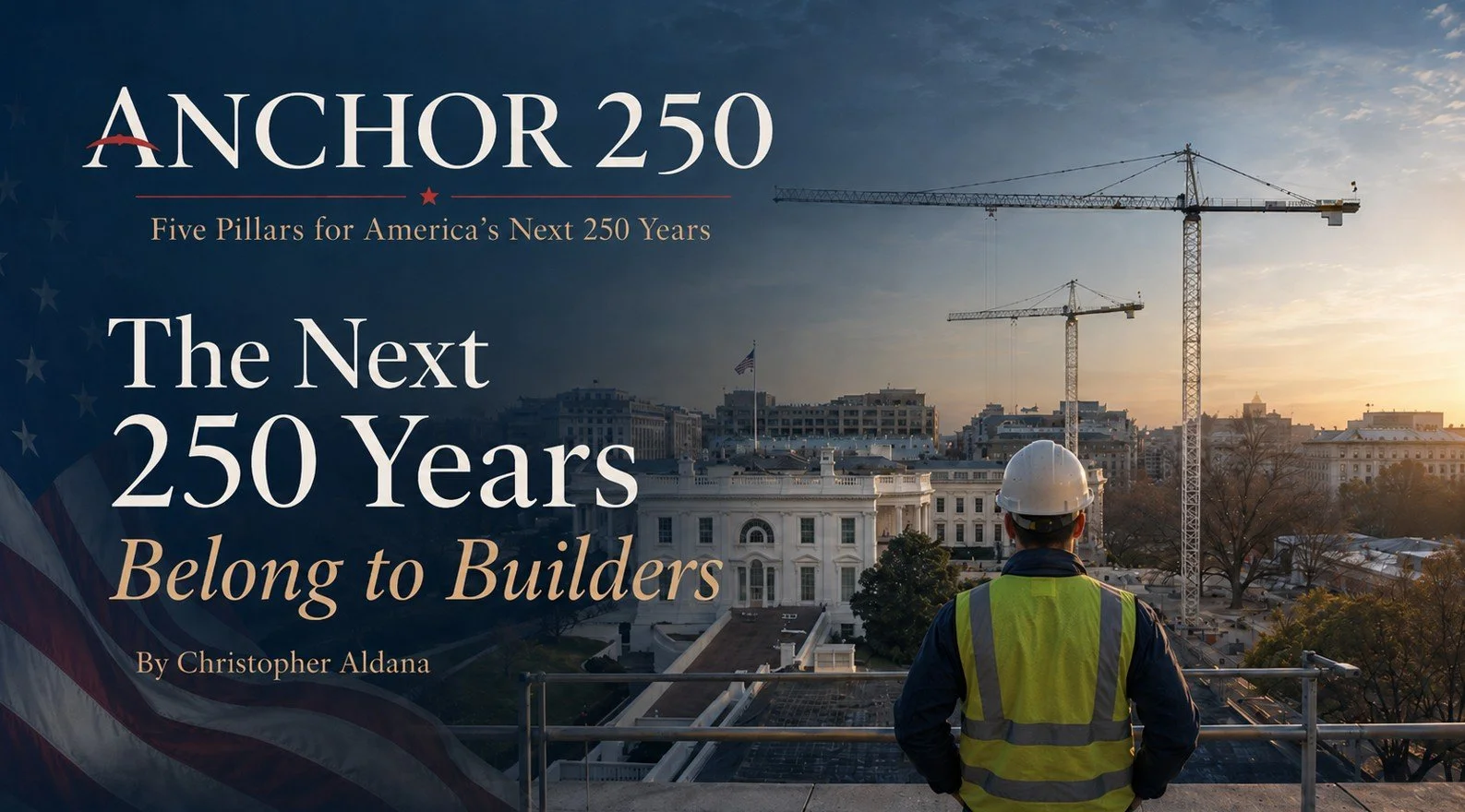
The Next 250 Years Belong to Builders
Recently, I found myself thinking about two very different ideas that, at first glance, seem to have very little in common. One was the Abraham Accords in the Middle East. The other was America’s upcoming 250th birthday. One involves nations that have spent generations navigating deep religious, political, and cultural divisions. The other involves a constitutional republic that has somehow managed to hold together people from vastly different backgrounds, beliefs, and experiences for nearly two and a half centuries.
The more I thought about them, however, the more I realized they both raise the same question: How do people with significant differences build a future together? It is a question that feels particularly relevant today. Everywhere we turn, we are encouraged to choose sides. Politics has become increasingly tribal. Social media often rewards outrage more than understanding. Public discourse frequently focuses on who is wrong, who should be blamed, or who must be defeated. Meanwhile, many of the challenges facing our communities continue to grow. Families are struggling. Mental health concerns are rising. Trust in institutions is declining. People feel disconnected from one another and uncertain about the future. In many ways, America is not suffering from a lack of opinions. We are suffering from a shortage of common purpose.
That is one of the reasons I find the Abraham Accords so interesting. The nations involved did not suddenly agree on theology. They did not erase centuries of history. They did not abandon their identities or convictions. Instead, they recognized that cooperation could create opportunities that perpetual conflict never could. The lesson was not that everyone agreed. The lesson was that they did not have to. They found enough common ground to move forward.
As I reflect on that example, I cannot help but think about what historians often call the American Experiment. For generations, scholars, leaders, and political thinkers have used that phrase to describe something unique in human history: the ongoing effort to sustain liberty, self-government, and opportunity among people who often see the world very differently. The American Experiment was never based on uniformity. It was based on the belief that free people could govern themselves while protecting the rights and dignity of others, even when disagreements existed.
That experiment was never guaranteed to succeed. In fact, its survival has always depended upon citizens who were willing to invest in something larger than themselves. For nearly 250 years, Americans have demonstrated that differences do not have to become divisions. We have repeatedly found ways to unite around shared principles, shared responsibilities, and a shared future. The question before us now is whether we still believe in that possibility.
As a Christian, I often think about how different Jesus’ ministry was from what many people expected. In His day, there were those who hoped the Messiah would arrive as a political leader who would overthrow existing power structures and establish a new government. Instead, Jesus focused on transforming lives. He taught truth, compassion, accountability, forgiveness, responsibility, and love. He changed the world not through force, but through influence. Not by conquering people, but by reaching their hearts.
Whether one views Jesus as Messiah, teacher, or historical figure, there is something profound in that example. Lasting transformation often begins with people before it is reflected in institutions. That principle has shaped much of my work in mental health and recovery. One of the most important lessons I have learned is that lasting change rarely comes from a single solution. People heal when multiple supports work together. Recovery requires stability, accountability, community, purpose, and hope. Remove any one of those elements, and the path becomes much more difficult.
Nations are not all that different. Strong nations are built upon strong foundations. They require systems that promote opportunity, responsibility, stability, and restoration. They require people who are willing to look beyond immediate conflicts and invest in long-term solutions. That conviction is what led to the creation of Anchor 250.
As America approaches its 250th birthday, I believe we need a conversation that extends beyond the next news cycle and beyond the next election. We need to think seriously about the next generation and the kind of nation we are building for those who will inherit it. Anchor 250 focuses on five pillars that I believe are essential to that conversation: immigration, energy, justice reform, small business, and mental health.
Reasonable people will disagree about specific policies within each of those areas. That is both expected and healthy in a free society. The goal is not to eliminate disagreement. The goal is to create solutions that strengthen the nation while preserving the dignity and freedom of the people who live within it. Secure borders contribute to order. Reliable energy contributes to independence and stewardship. Justice reform contributes to accountability and restoration. Small businesses create opportunity, innovation, and local prosperity. Mental health recovery strengthens individuals, families, and communities. These are not merely political issues. They are nation-building issues.
Throughout our history, Americans have often found themselves balancing values that appear to compete with one another. We value both freedom and responsibility. We value both accountability and compassion. We value both opportunity and support for those facing hardship. The healthiest societies do not choose one value at the expense of the other. They learn how to hold them together. Compassion without accountability can create dependency. Accountability without compassion can create despair.
The goal is not simply to help people survive difficult circumstances. The goal is to help people move toward stability, purpose, dignity, and self-sufficiency. That is true in recovery. It is true in families. It is true in communities. And I believe it is true for nations.
As America enters its next chapter, we face a choice. We can continue defining ourselves primarily by our disagreements, allowing every issue to become another line of division. Or we can become builders. Builders are not people who agree on everything. They are people who care enough about the future to work together despite their differences. They understand that every generation inherits a nation it did not create and bears responsibility for the nation it will leave behind.
The Abraham Accords remind us that cooperation is possible. The American Experiment reminds us that freedom can survive disagreement. Anchor 250 asks a simple question: What are we building for the next generation?
America’s first 250 years were built by people who invested in a future they would never fully see. The question now is whether we are willing to do the same. Because in the end, the next 250 years will not belong to those who win the loudest arguments. They will belong to those who build.
That is the mission of Anchor 250.
Not the next election.
The next generation.